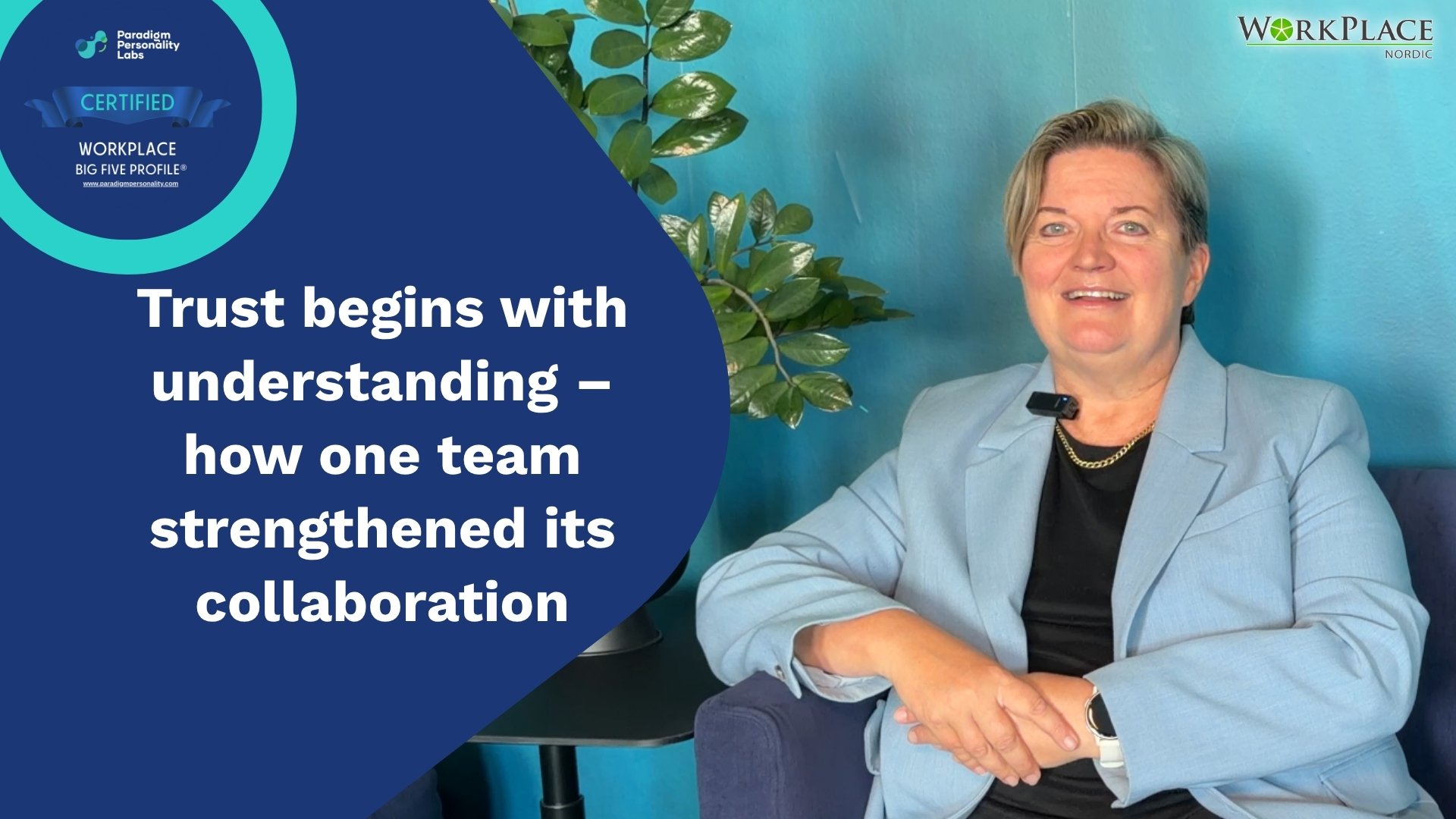
How can you reduce misunderstandings and build trust in a team whose members come from different backgrounds, cultures, and working environments? The WorkPlace Big Five Profile® personality assessment helps identify individual natural behavioural tendencies and create a shared understanding of how people work together. Kristiina Pihlaja, CEO of Careerjoy Oy, shares a real-life client example of how greater self-awareness and an appreciation of individual differences helped a team build trust and improve collaboration.
Better teamwork starts with self-awareness
Kristiina Pihlaja recalls working with a team where misunderstandings and friction were affecting collaboration. The team members came from very different backgrounds and cultures, creating additional challenges for working together effectively.
The development process began with each team member completing an individual WorkPlace Big Five Profile® assessment, followed by a one-to-one feedback session.
These discussions gave participants an opportunity to explore their natural ways of working, recognise their strengths, and reflect on potential areas for development. For some team members, this was their first experience with a personality assessment.
Individual reflection provided an important foundation for the team workshops that followed. Once participants had gained a better understanding of their own behavioural tendencies, they were better equipped to explore differences within the team and how these influenced collaboration.
Trust grows when differences become visible
The primary goal of the first team workshop was to strengthen mutual trust. Pihlaja introduced an interactive exercise known as a scale walk, which made the similarities and differences between team members visible in a practical and engaging way.
The exercise sparked lively discussions and helped create a more open atmosphere. Participants gained new perspectives on why a colleague might react to the same situation in a completely different way.
Pihlaja describes the exercise as one of the most effective conversation starters she has experienced. It helped team members understand each other better and build greater mutual trust.
Understanding team dynamics through blend quadrants
In the second workshop, the team explored its dynamics in greater depth using blend quadrants based on the WorkPlace Big Five Profile®.
These quadrants illustrated differences in team members’ natural tendencies and approaches to situations involving for example stress, conflict, and collaboration.
An important aspect of the exercise was that the quadrants were presented anonymously. Rather than focusing on individual team members, the discussions centred on different behavioural tendencies within the team and how they influenced working together.
This approach created a safe and constructive setting for discussing topics that might otherwise have been difficult to address openly.
One of the key insights was that there is no single right way to approach situations or collaborate with others. Different approaches can all bring value to a team, but making the most of them requires mutual understanding and open dialogue.
A personality profile does not define a person
One of the most valuable insights from the workshops concerned the relationship between personality and behaviour.
While the WorkPlace Big Five Profile® helps identify an individual’s natural behavioural tendencies, a personality profile does not mean that someone will behave in the same way in every situation.
Behaviour is also influenced by context, environment, and the different roles we take on. The same person may behave differently at work, at home with their family, or in their free time.
Pihlaja compares a personality profile to a personal user manual. It helps people understand their natural ways of thinking and behaving, while recognising that they can adapt their behaviour to different situations.
Open dialogue lays the foundation for stronger teamwork
In the team Pihlaja facilitated, growing self-awareness and mutual understanding began to make a difference in everyday collaboration.
As participants developed a better understanding of each other’s natural ways of working, misunderstandings decreased and working together became easier. Team members learned to recognise the value of individual differences and became more considerate of their colleagues’ preferred approaches.
According to Pihlaja, however, the most significant outcome of the process was not simply the personality profiles or the exercises themselves.
What mattered most was that the team took the time to reflect on how they worked together.
When people have the opportunity to discuss openly and without judgement how they behave and interact with others, they create a foundation for stronger trust and more effective collaboration.
The WorkPlace Big Five Profile® provided a shared language and a clear structure to support these conversations.
WorkPlace Big Five Profile® provides practical tools for team development
Effective teamwork does not require everyone to think or behave in the same way. Quite the opposite: different perspectives and ways of working can become valuable strengths when people learn to understand and appreciate them.
The WorkPlace Big Five Profile® helps make natural behavioural tendencies visible and provides coaches, leaders, and organisations with practical tools for developing self- awareness, strengthening interpersonal understanding, and improving collaboration.
About Kristiina Pihlaja
Kristiina Pihlaja is the CEO of Careerjoy Oy, an HR professional, and a coach. She uses the WorkPlace Big Five Profile® assessment in her work to strengthen self-awareness, build mutual trust, and support more effective team collaboration.
Watch the video below!