Organizations are constantly embarking on transformations, integrations and new strategic initiatives. Yet, alongside careful planning, one crucial factor in the success of organizational change may receive too little attention: How well does the team driving the change work together – and how do the demands on the team evolve as the project progresses?
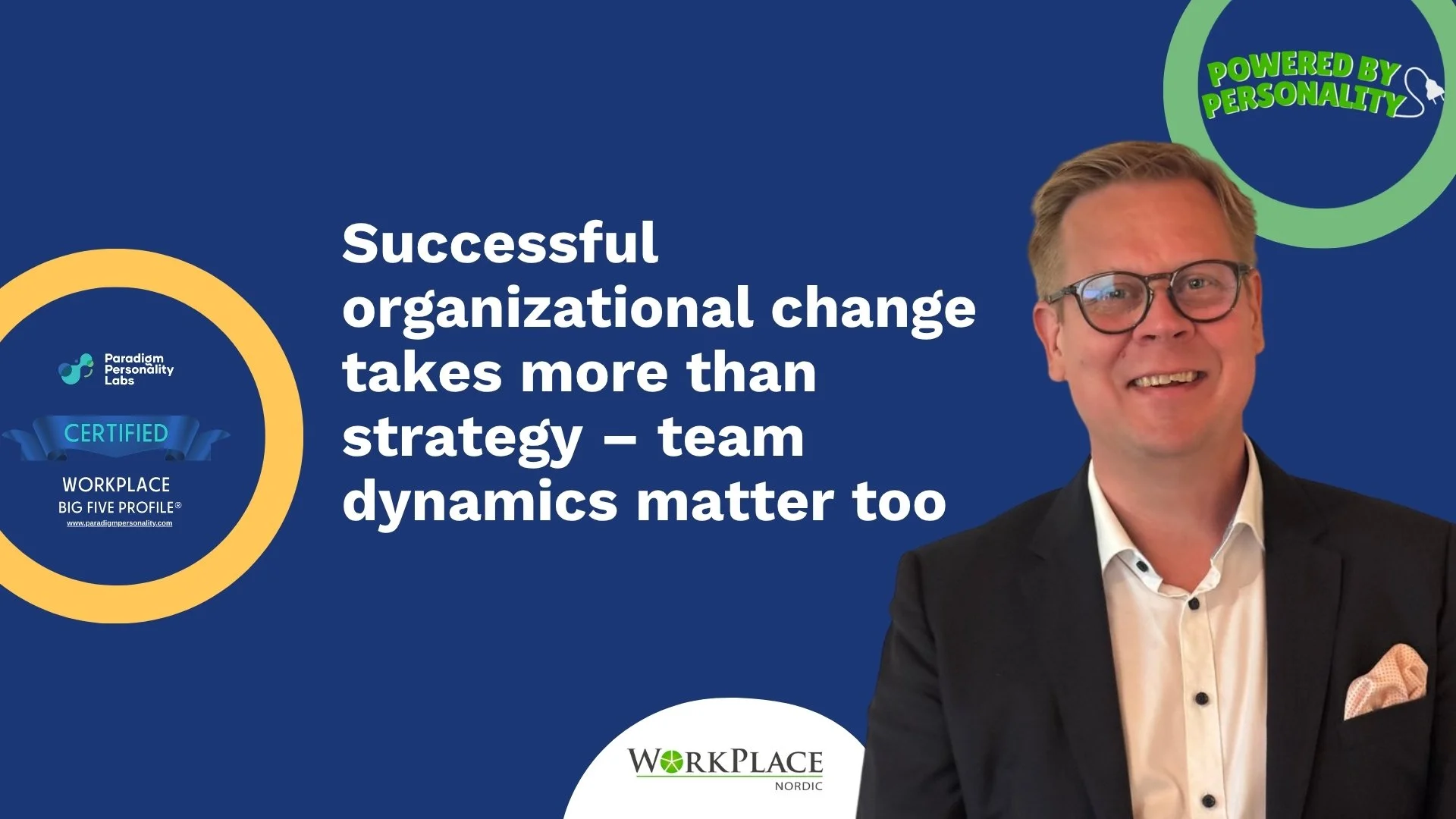
Jaakko Virkki, a commercialization and business consultant, has worked in business management roles where organizations face increasing demands for growth, transformation and efficiency. Becoming certified in the WorkPlace Big Five Profile® has brought a new perspective to his work: the opportunity to examine organizational change through people’s natural behavioural tendencies.
Virkki explains how the WorkPlace Big Five Profile® can help teams better understand their ways of working and team dynamics throughout the different stages of a change initiative.
Read on to discover why successful organizational change requires not only a clear strategy, but also a deeper understanding of how people work together – and which natural behavioural tendencies are most valuable at different stages of the transformation.
Different stages of change require different ways of working
Major organizational change initiatives can take years to complete. When planning a transformation, attention naturally turns to what needs to be achieved: objectives, structures, timelines, resources and responsibilities.
According to Virkki, there is another equally important perspective to consider: the people responsible for making the change happen.
What kind of team is driving the transformation? How do its members make decisions, respond to different perspectives and move things forward? And what happens when the project moves from one stage to the next?
The lifecycle of a change initiative can be viewed through three distinct stages: initiation, implementation and stabilization.
During the initiation stage, teams need the ability to analyse the current situation, define direction, set objectives and explore new approaches.
As the project moves into implementation, the focus increasingly shifts towards decision- making and turning plans into action. Equally important is the ability to engage others and bring people along on the journey.
Towards the final stage, the demands change again. Attention turns to embedding new ways of working into everyday operations, managing details, completing tasks, taking responsibility and ensuring people’s commitment to the change.
This leads to an important insight: different stages of a change initiative call for different ways of working.
A team that naturally excels at initiating change and developing new ideas may not be equally comfortable with the detailed work of implementation and stabilization – and vice versa.
Personality influences how change teams work together
People bring more than their skills and experience to a change team. They also bring their natural ways of thinking, behaving and working.
One person may quickly seek clarity and focus, while another prefers to explore different possibilities. One may be ready to make decisions and move forward, while another wants to examine the situation more thoroughly. Some people are naturally energised by innovation and new ideas, while others pay closer attention to making sure that new ways of working function effectively in practice.
These differences are not inherently strengths or weaknesses. What matters is understanding how different behavioural tendencies influence collaboration – and how they can contribute at different stages of a change initiative.
The WorkPlace Big Five Profile® is based on five main personality traits (supertraits) and 23 subtraits. It helps individuals and teams gain a clearer understanding of their natural behavioural tendencies in the workplace.
When the focus expands from individuals to the entire change team, the assessment provides a practical foundation for discussing questions such as:
How does the team typically make decisions?
In which situations might different perspectives create friction?
What helps the team maintain focus and momentum?
What kind of support might the team need at different stages of the project?
By making these patterns more visible, teams can develop a better understanding of how their natural ways of working influence their ability to implement change together.
What if the team’s natural strengths do not match the next stage of change?
Understanding personality is not about identifying one ideal personality profile for a successful change team. There is no such profile.
Instead, recognizing the team’s natural behavioural tendencies helps uncover potential challenges and opportunities before they emerge in everyday collaboration.
For example, if a team naturally makes decisions quickly, when might it benefit from slowing down and taking a more thorough approach?
If the team has a strong natural preference for developing new ideas and driving innovation, who will ensure that the necessary details are addressed and that the changes become established practices?
And if team members have very different preferences regarding structure, flexibility or change itself, how can these differences be discussed constructively before they become sources of friction?
This is where personality assessment moves beyond describing individuals and becomes a practical tool for planning and improving collaboration.
Understanding team dynamics supports more effective change planning
The WorkPlace Big Five Profile® helps make team members’ natural behavioural tendencies visible and allows teams to examine them in relation to their shared objectives.
In the context of organizational change, this can help anticipate which strengths the team is likely to bring to different stages of a project – and where its ways of working or collaboration may require more conscious attention and support.
Virkki’s perspective is particularly relevant to long-term transformation initiatives.
When a team’s natural behavioural tendencies are understood before the project begins, or at an early stage, organizations can make more informed decisions about team composition, responsibilities, ways of working and the support needed throughout the transformation.
The same principle also applies to the relationship between the board of directors, the executive team and the operational organization.
The natural behavioural tendencies of people in different roles influence how decisions move from strategic plans into everyday practice.
After all, a strategic decision alone does not change how an organization operates. Real change happens through people’s actions.
Strategy defines what needs to change – people determine how it happens
A good strategy provides direction for change. A project plan provides structure.
But neither tells the whole story of how a particular group of people will succeed in implementing the change together.
This is why planning a successful transformation requires looking beyond skills, expertise and responsibilities to understand the dynamics of the team driving the change.
Where does the team naturally perform at its best? In which situations would it benefit from a more deliberate approach? And how can different individuals’ natural ways of working be brought together to support the project when they are needed most?
As Virkki points out, it is ultimately people who turn strategic plans into meaningful change in everyday work.
Would you like to use the WorkPlace Big Five Profile® to develop the performance and collaboration of your executive team, leadership team or change team? Explore the WorkPlace Big Five Profile® and discover how it can support team development.
About Jaakko Virkki
Jaakko Virkki is a commercialization and business consultant at JVC, a consultancy helping companies with commercialization, go-to-market development and strategy execution. Jaakko uses the WorkPlace Big Five Profile® to explore the natural behavioural tendencies and dynamics of change teams, helping organizations better understand how people work together and supporting the successful implementation of organizational change.
Watch the video below!