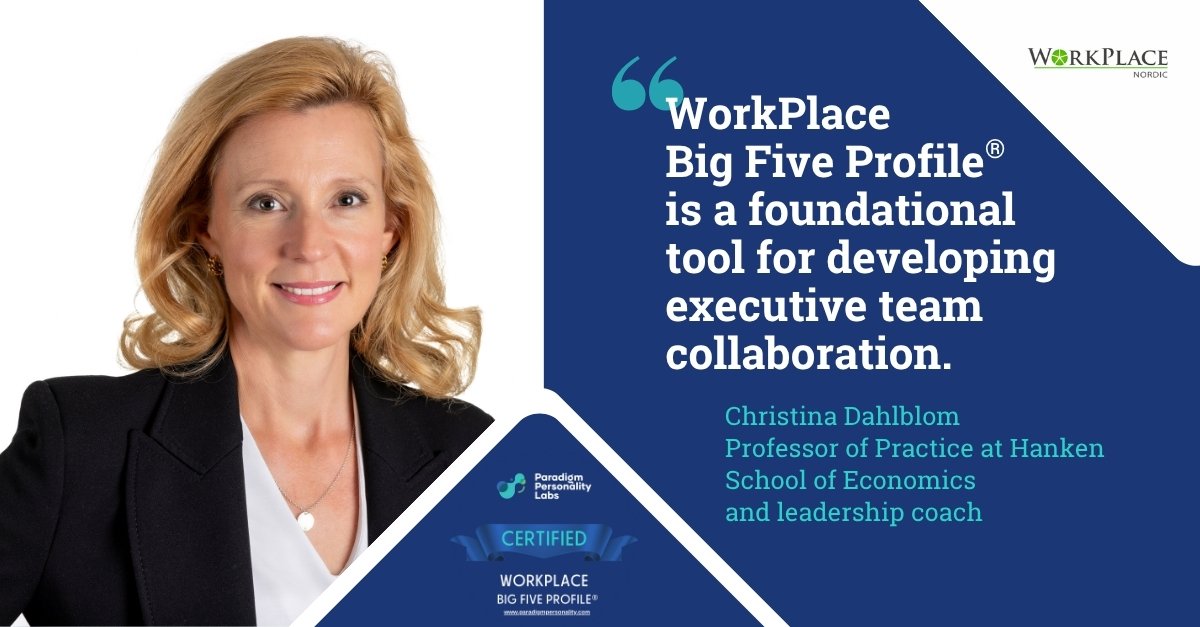
Hanken Professor of Practice: WorkPlace Big Five Profile is a foundational tool for developing executive team collaboration
Understanding personality—and thus each other’s natural ways of working, as well as the energy dynamics within a team—provides a powerful starting point for executive team development, says Christina Dahlblom, Professor of Practice at Hanken School of Economics and leadership coach.
Grounded in rigorous scientific data—yet at the same time fast, easy to use, engaging, and insightful.
Christina Dahlblom, who works as a leadership coach and Professor of Practice in the Department of Management and Organisation at Hanken School of Economics in Finland can offer many reasons why the WorkPlace Big Five Profile® has been one of her core tools already for over a decade.
“Having a shared vocabulary for describing yourself and understanding others is invaluable. I use the tool extensively with my clients—including very experienced leaders and executive teams. At Hanken, I have also used the profiling with students, and it has proven highly useful there as well,” Dahlblom explains.
A safe, scientific way to address even difficult topics
When an executive team brings Dahlblom in, it is often in the context of change—such as a new leader, new team members, or a reorganization.
Another common situation is when the team is experiencing problems in their co-operation.
“When a team develops a deeper understanding of one another and gains insights into the different energies present in the team, it lays an incredibly strong foundation for discussing even difficult topics in a safe and scientifically grounded way—regardless of the starting point,” Dahlblom says.
A language that becomes part of everyday work
For many of Dahlblom’s clients, the WorkPlace Big Five Profile has become a shared language that they want to use in their daily work. For example, when a CEO joins a new organization, they often begin by looking at their new executive team through the lens of the WorkPlace Big Five Profile. Similarly, new team members are often profiled when entering the team.
“In many of my client organizations, the WorkPlace Big Five Profile has become a foundational tool for developing executive team collaboration,” Dahlblom notes.
She also highlights the strength of the tool’s semantics.
“The terminology is carefully designed so that no one is seen as better or worse than others. When addressing sensitive or complex topics, the choice of words is crucial in creating a psychologically safe environment.”
Understanding and optimizing team energy
Dahlblom also emphasizes the value of the WorkPlace Big Five Profile as a tool for understanding and managing energy.
It helps executive teams recognize what energizes different individuals, what may drain energy, and how ways of working and interacting can be optimized to enhance collective performance.
“Personality profiling makes it visible if certain types of energy are missing from the team. For example, executive teams often include highly strategic individuals. But if no one is naturally inclined towards structured planning, implementing strategy can become challenging,” Dahlblom explains.
This awareness alone can help explain why certain initiatives—such as strategy execution—may not progress as expected. From that understanding, teams can make conscious decisions to address the gap: Someone may take on a new role intentionally, recruitment can focus on bringing in complementary profiles, or the team can agree on new ways of working that support execution.
“There are many ways to compensate, but the starting point is understanding what is missing—what does not come naturally to anyone in the team. That is a powerful foundation for development,” she says.
Valuable even for highly experienced leaders
Even highly experienced leaders and executive teams benefit from the WorkPlace Big Five Profile, Dahlblom points out—despite often having used multiple other assessments throughout their careers.
“The Big Five stands out because it is grounded in data and empirical research, and thus it is not just a theory. It also avoids stereotyping. In my experience, the subtraits of the profile in particular provide very concrete direction for where to focus development efforts,” she explains.
The way profiles are explored and discussed within the group has also received strong positive feedback from experienced leaders.
“It often leads to meaningful insights about oneself and others—and that creates real value. Another key strength of the WorkPlace Big Five Profile is that it is not a ‘magic mystery box’ like some other models. Full transparency is provided and as a certified practitioner you can always go back and see where the results come from. That makes it extremely credible,” Dahlblom adds.
WorkPlace Big Five Profile® in developing executive team collaboration
Creates a shared language that enables safe and constructive dialogue—even around difficult topics
Provides insights into one’s own and others’ personality traits, and how these influence team performChristina Dahlblomance
Offers concrete direction for where to focus development efforts
———
Christina Dahlblom is an experienced leadership coach, board professional, and Associate Vice Rector at Hanken School of Economics, where she serves as Professor of Practice in the Department of Management and Organisation.