Greater Mutual Understanding Boosts Executive Team Performance
Understanding your own and others’ personalities helps executive teams improve their ways of working and leverage differences as strengths, say leadership coaches Raisa Jyrkinen and Tomi Tuomasjukka.
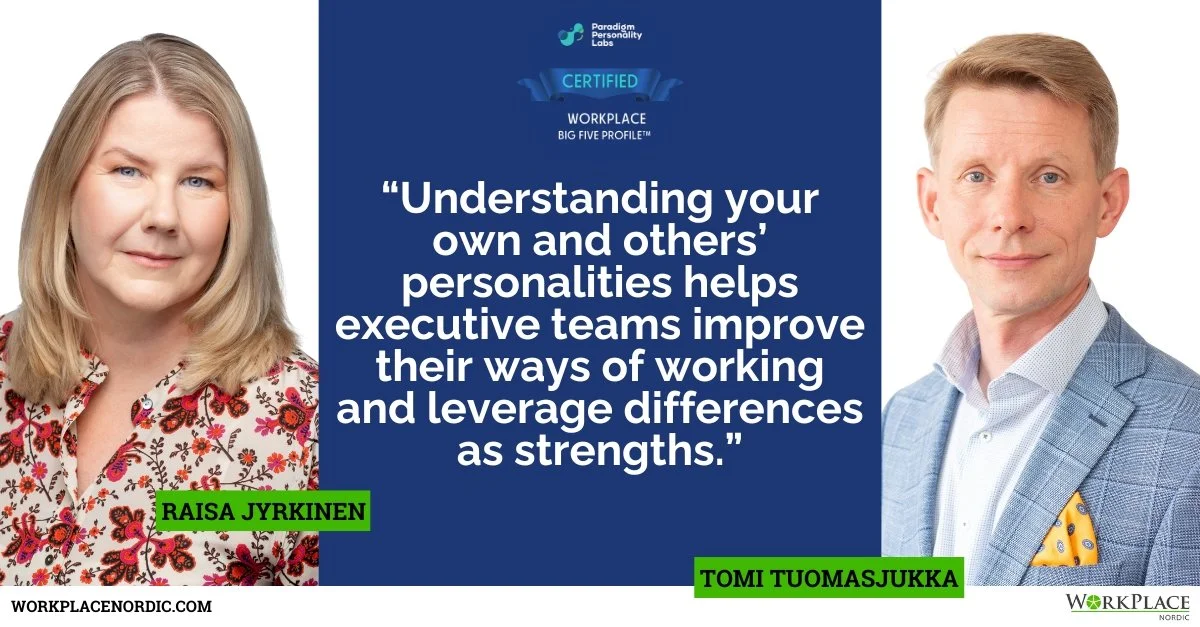
The executive team has a greater impact on a company’s success than any other leadership group, which is why it’s worth investing in how it operates, says executive and team coach Tomi Tuomasjukka.
“There are companies and organizations whose executive teams are, encouragingly, already paying attention to functioning better as a team. But based on my observations, awareness and utilization of personality differences in working life are still far too limited,” Tuomasjukka states.
Leadership and expert coach Raisa Jyrkinen agrees. Both support executive teams in improving their collaboration through executive team coaching and training.
“When mutual understanding and empathy grow, collaboration becomes more effective and productive,” says Jyrkinen.
To support their work, both use the scientifically validated WorkPlace Big Five Profile™ personality profiling tool.
Advancing to the Next Level
Executive teams reach out to Jyrkinen or Tuomasjukka for a variety of reasons.
“The ideal situation is when the team recognizes it wants to develop and take its collaboration to the next level—though that’s still relatively rare,” Tuomasjukka notes.
Often, team development efforts begin when there’s a challenge or a sense of disconnection within the group.
“Another common starting point is when a newly formed executive team begins to define its purpose, establish shared practices, and get to know one another,” Jyrkinen explains.
Conscious Adjustments in Behavior
The purpose of personality profiling is to clarify the team members’ natural behavioral tendencies. The profile often reveals concrete areas for development.
In coaching sessions, a common area of focus is how team members express their views—some are more naturally outspoken than others.
“In meetings, a few individuals may dominate the conversation because taking space comes naturally to them. Others may hold back. When the team becomes aware of this, facilitation can be adapted to ensure all voices are heard,” Jyrkinen says.
On the other hand, a group might naturally focus on the big picture and overlook important details.
“If no one in the group is particularly detail-oriented, the team can make a conscious effort to ensure this perspective is not neglected,” Jyrkinen continues. “When individuals become aware of their natural behavioral tendencies, they can make conscious adjustments to how they behave and interact in their work environment. It’s important to note that the WorkPlace Big Five doesn’t assess skills or performance capability, but natural behavioral patterns. These are two separate things.”
Leveraging Differences as Strengths
At its best, the WorkPlace Big Five Profile™ helps teams harness personality differences and diverse strengths, Tuomasjukka explains.
“It builds self-awareness and awareness of others, which increases tolerance and the ability to accept different reactions and viewpoints.”
This understanding encourages openness.
“I’ve heard many people say that as their understanding of others has grown, they’ve felt more comfortable being open in interactions and sharing their own perspectives,” Jyrkinen adds.
A Common Language for Important Conversations
Personality profiling provides the team with a shared language, making it easier to have meaningful conversations.
“Executive teams are typically highly analytical and numbers-driven. In companies with technical expertise, a scientifically validated tool like WorkPlace Big Five lowers the threshold for discussing people-related topics. No one has ever questioned the reliability of the tool,” says Tuomasjukka.
Feedback from executive teams has been consistently positive.
“What I appreciate about the WorkPlace Big Five Profile™ is that it doesn’t label people. It’s based on the idea that all of us possess aspects of each personality trait,” Jyrkinen says.
WorkPlace Big Five in Executive Team Development
Encourages dialogue and increases openness
Helps in accepting and utilizing personality differences and diverse strengths
Enhances team performance
Based on a widely researched and reliable model of personality.
———
Raisa Jyrkinen is an experienced HR professional and coach for leaders and specialists.
Tomi Tuomasjukka is a seasoned executive and team coach, workplace mediator, and professional supervision coach.